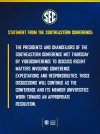
SOMETHING is going on, because what we know publicly doesn't add up.
Texas is Texas, I get that.
but you telling me Missouri, South Carolina, and Kentucky are voting for this because LSU might maybe add former "pro players" when they themselves are trying to do the same thing?
I mean if I'm an SEC president at one of those schools and I see them going after LSU, I'd wonder what's to stop them from coming after one of those schools going forward?
So I was curious who Missouri, SCar, and Kentucky went after and how they differ from LSU. After all, I hadn't heard about any of the three.......because who cares about any of them compared to LSU.
Now, up front I want to tell you my job has turned me into one of the biggest haters of AI that exists. We're having it crammed down our throats and they're tracking our usage. It sucks. I am not a fan..........but it does give answers. I do not know how valid these answers are, and I will readily admit when an AI decides things are "quietly prepared" (describing Missouri) vs LSU "aggressively" pursuing players for a "competitive edge"........that sounds like when my brother told his version of what happened to the broken window in the garage when we were kids.
However, I asked Google's AI if Missouri went after any ex NFL players, and was told the name of one guy. I then asked what the difference was between that and LSU, and was told this:
DumbDumbAI said:
The Missouri situation and the massive controversy surrounding LSU differ primarily in the scope of the plan, the level of conference defiance, and the ultimate resolution.
While Mizzou quietly prepared a single spot for one of its own returning players (Sterling Webb), LSU’s new head coach Lane Kiffin actively targeted outside ex-pros to build a competitive edge. This aggressive strategy triggered an unprecedented legal showdown that nearly resulted in LSU being expelled from the SEC.
The key differences break down across four areas:
1. Recruiting vs. Welcoming Back
- Missouri: The Tigers were simply trying to welcome back an undrafted homegrown player. Sterling Webb had played for Mizzou, went to a single Buffalo Bills rookie minicamp, and wanted to return to his original school.
- LSU: Lane Kiffin went shopping in the NFL discard pile. He signed players like tight end Dae'Quan Wright (Cleveland Browns) and defensive tackle Zxavian Harris (New Orleans Saints). Neither had played for LSU previously; Kiffin actively recruited them using massive Name, Image, and Likeness (NIL) deals.
2. Scale of the Legal Strategy
- Missouri: Webb filed an isolated lawsuit in a local Missouri court to secure his personal eligibility via a temporary restraining order.
- LSU: LSU's situation was part of a sprawling, multi-athlete class-action strategy. A Louisiana judge granted a sweeping preliminary injunction covering over 40 athletes, explicitly clearing a path for ex-pros to bypass NCAA restrictions.
3. The SEC's Nuclear Response
- Missouri: Because Mizzou's involvement was passive and contingent on the court's ruling, the SEC did not heavily penalize or publicly threaten the university.
- LSU: The SEC viewed LSU’s aggressive recruitment of ex-pros as an existential threat to competitive fairness. The conference filed a federal countersuit in Alabama and threatened to vote on expelling LSU from the SEC entirely if they allowed the ex-NFL players to suit up.
4. The Final Roster Outcomes
- Missouri: Mizzou kept a roster spot open dynamically while waiting to see how Webb’s individual legal battle played out.
- LSU: Facing total expulsion from the conference, LSU blinked and backed down. They filled their final roster spots with traditional players, completely locking out Wright and Harris for the 2026 season.
I then asked how South Carolina and Kentucky compared to either approach:
DumbDumbAI said:
The situations at South Carolina and Kentucky mirrored the absolute chaos of the ex-NFL player eligibility battle, but they differed heavily in legal outcomes, geographic strategy, and multi-sport overlap.
Here is how South Carolina and Kentucky stack up against Missouri's passive waiting game and LSU's massive, high-stakes showdown:
South Carolina: The Aggressive Pursuit with a Legal Dead EndSouth Carolina’s approach was much closer to LSU's aggressive recruitment model.
- The Strategy: Head coach Shane Beamer actively went after these newly available ex-NFL rookies. In fact, South Carolina was a major finalist to land tight end Dae'Quan Wright before he chose Lane Kiffin and LSU.
- The Legal Result: Unlike LSU's favorable Louisiana court ruling, South Carolina's efforts were completely halted by local courts. A South Carolina judge denied a temporary restraining order filed by several former players seeking a fifth year of eligibility. This effectively killed the Gamecocks' ability to roster any ex-NFL players before the 2026 season kicked off.
Kentucky: The Local Intervention and Multi-Sport Fallout
Kentucky found itself dealing with the crisis across two completely different sports, blending elements of Missouri's localized legal approach with unique transfer rule complications.
- Football: Kentucky linebacker Alex Afari Jr. attempted to force his way back onto the field by officially joining a local lawsuit in a Louisville circuit court to fight the NCAA for his fifth year of eligibility.
- Basketball (The Mark Mitchell Twist): Kentucky’s situation grew even more complex when basketball transfer Mark Mitchell (who came from Missouri) had his eligibility challenged by the SEC. While Mitchell didn't play in the NFL, the SEC aggressively cracked down on his transfer window because they were simultaneously panicked over the LSU football situation. Kentucky's legal camp has been forced to argue his case under the same shifting landscape.
| University |
Strategy Type |
Legal Outcome |
Final Status for 2026 |
| LSU |
Ultra-Aggressive Recruiting |
Injunction granted, but sued by SEC |
Backed down; left players off Week 1 roster |
| Missouri |
Passive / Homegrown |
Awaiting local TRO |
Kept spot open dynamically |
| South Carolina |
Aggressive Recruiting |
TRO Denied by state judge |
Blocked from rostering ex-NFL talent |
| Kentucky |
Localized Lawsuit Player-Side |
Pending via local intervention |
Roster status stalled in court |
So seeing things like "Ultra-Aggressive" for LSU vs just "Aggressive" for South Carolina raises my eyebrows in the same way seeing you pretend like LSU was just sitting idly by hoping NFL players fell into their laps through no intervention of their own.......I can also understand exactly why LSU is being treated differently from these other schools. Specifically:
- Missouri was just trying to get a Missouri kid back. (still shouldn't be allowed, but not the same as what LSU is doing).
- South Carolina was denied by their state judge who seemingly isn't a foosbawl homer. (no need for SEC intervention at this point).
- Kentucky had a former Kentucky player trying to come back....same as Missouri...for football. For basketball, the SEC apparently has a rule that prevents intra-conference transfers. Mark Mitchell was trying to go from Missouri to the NBA to Kentucky, the SEC said nah, Mark Mitchell backed out of his commitment to Kentucky and is now trying to get back to Missouri. (shouldn't be allowed, but different).
It's now more understandable why those other schools aren't facing a lawsuit from the SEC at this time. And, if this AI summary is accurate, underscores my initial response to your version of what LSU did vs reality. In the same way you try to paint Kiffin in the light of jUsT tRyInG tO dO hIs JoB aNd BuIlD tHe BeSt RoStEr He CaN wItHiN tHe RuLeS........the SEC is trying to pRoTeCt CoMpEtItIvE fAiRnEsS.
I think if you really want an answer into why LSU is being picked on and the other schools aren't....it's some combination of the above and the fact that nobody gives a shit about Missouri, South Carolina, or Kentucky football, and none of them have a shitbag coach like Lane Kiffin.