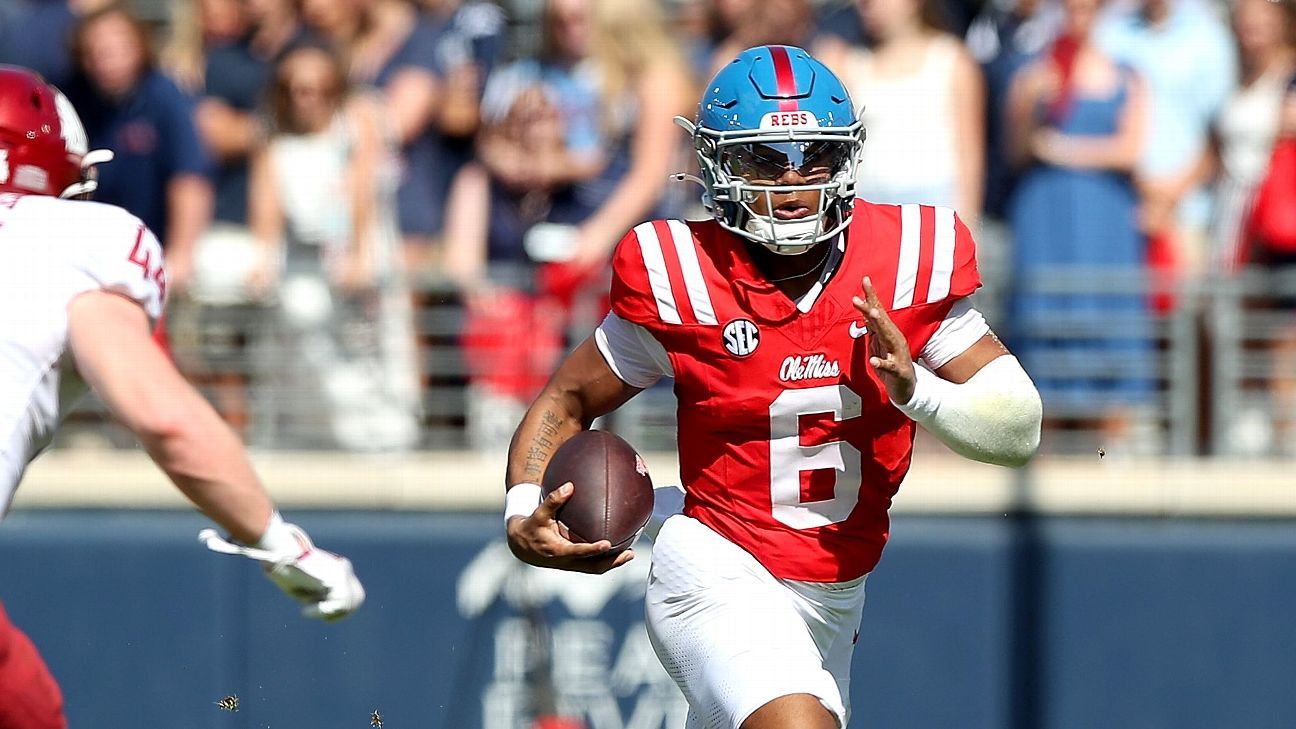
Lawyers for Ole Miss quarterback Trinidad Chambliss have sued the NCAA in Mississippi court, seeking one more season of eligibility with the Rebels.

www.espn.com
Lawyers for QB Trinidad Chambliss sue NCAA in Mississippi court
Lawyers representing Ole Miss quarterback Trinidad Chambliss sued the NCAA on Friday, asking a judge in the Chancery Court of Lafayette County, Mississippi, for preliminary and permanent injunctions that would allow him to play one more season for the Rebels.
The NCAA denied Chambliss a waiver for a sixth year of eligibility on Jan. 9, ruling that Ole Miss officials and Chambliss didn't provide adequate medical evidence by a treating physician that showed he was suffering from an "incapacitating injury or illness," which is required for approval of a waiver.
Chambliss claimed he dealt with persistent respiratory issues as a sophomore at Division II Ferris State in 2022, which is why he didn't play that season.
"In Trinidad's case, the NCAA failed in its mission to foster his well-being and development as a student-athlete," the lawsuit says. "The mechanisms (i.e., waiver rules) for granting Trinidad an additional year of eligibility -- so that he has the opportunity to compete in four years of college football -- are available and within the NCAA's control.
"Despite the duty of good faith and fair dealing it owes Trinidad, the NCAA insists on considering the evidence in Trinidad's case in an isolated, rather than comprehensive, manner; interpreting its rules to impose requirements not contained therein; taking unreasonable if not irrational positions; and acting in an arbitrary and capricious manner in its decision-making and ruling."
.
.
continued
.
.
Chambliss has already signed to play for the Rebels in 2026. His deal, including incentives, might be worth as much as $6 million, according to sources.
The case differs in that most lawsuits filed by players wanting an additional year of eligibility have been filed in federal courts and allege the NCAA violated federal antitrust laws. (Note: Like Ohio State basketball player Puff Johnson's case).
"We're not challenging the legality of any NCAA rules," Mars told ESPN on Friday. "To the contrary, we're asking that they be applied as written based on the totality of the circumstances, as required by internal NCAA policy, without ignoring certain evidence, misconstruing other evidence, and using arbitrary and tortured interpretations of the language the NCAA used to create the rules."
.
.
.
continued