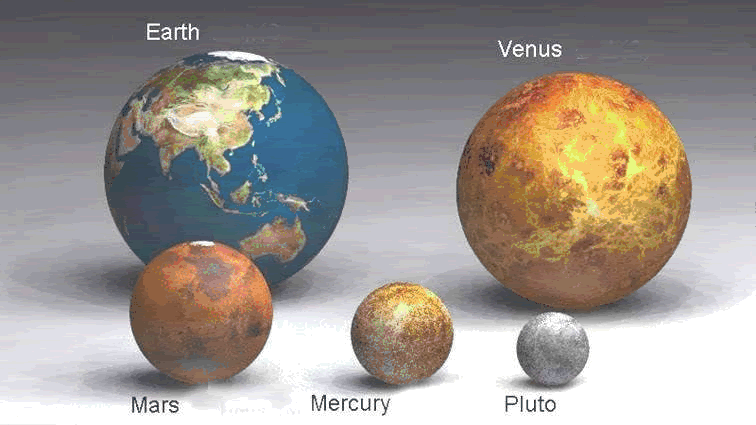
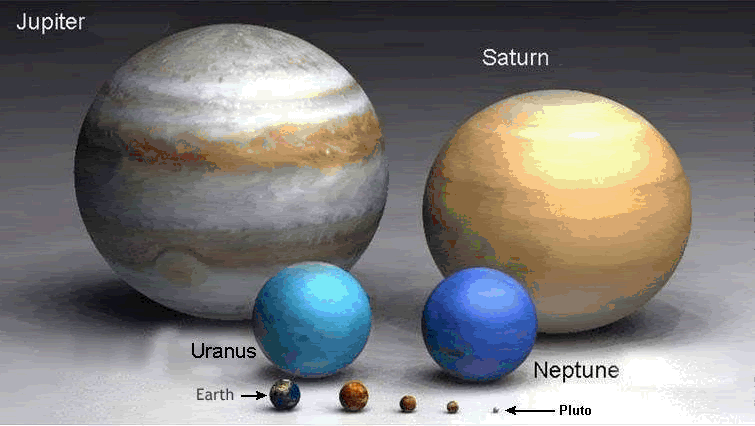
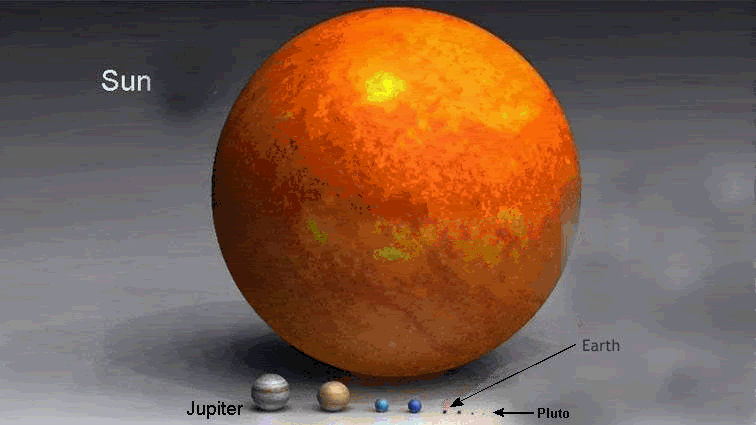
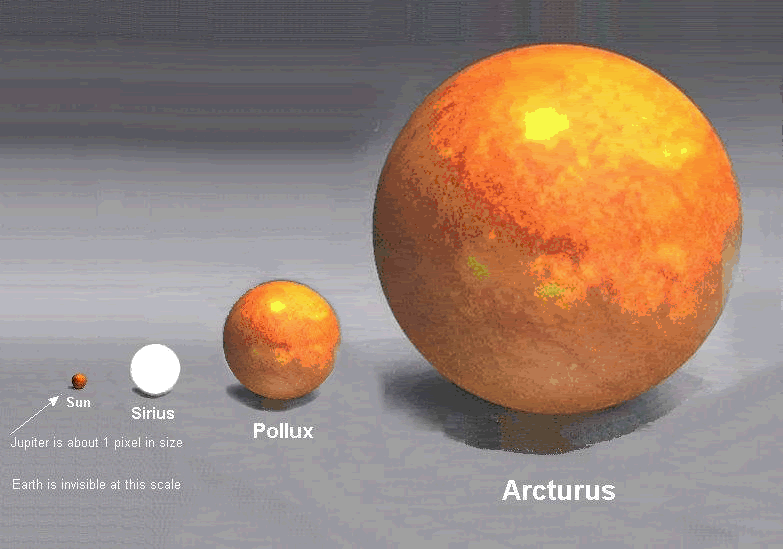
Talk about small...
[Apologies for the long post, I couldn't resist under the circumstances. This is from the opening of Carl Sagan's Pale Blue Dot.]
"The entire Earth is but a point, and the place of our own habitation but a minute corner of it", said Marcus Aurelius, the Roman Emperor, around 170.
"As the astronomers unanimously teach, the circuit of the whole Earth which to us seems endless, compared with the greatness of the Universe, has the likeness of a mere tiny point", said Ammianus Marcellinus, the last major Roman historian.
---
The spacecraft was a long way from home, beyond the orbit of the outermost planet and high above the ecliptic plane -- which is an imaginary flat surface we can think of as something like a racetrack in which the orbits of the planets are mainly confined. The ship was speeding away from the Sun at 40,000 miles an hour, but in early February of 1990 it was overtaken by an urgent message from Earth. Obediently, it turned its cameras back toward the now-distant planets. Slewing its scan platform from one spot in the sky to another, it snapped sixty pictures and stored them in digital form on its tape recorder. Then, slowly, in March, April and May, it radioed the data back to Earth. Each image was composed of 640,000 individual picture elements, or pixels, like the dots in a newspaper wire photo or a Pointillist painting. The spacecraft was 3.7 billion miles from Earth, so far away that it took each pixel five and a half hours traveling at the speed of light to reach us.The pictures might have been returned earlier, but the big radio telescopes in California, Spain, and Australia that receive these whispers from the edge of the solar system had responsibilities to other ships which ply the sea of space -- among them, Magellan, bound for Venus and Galileo on its tortuous passage to Jupiter.
Voyager 1 was so high above the ecliptic plane because in 1981 it had made a close pass by Titan, the giant moon of Saturn. Its sister ship, Voyager 2, was dispatched on a different trajectory, within the ecliptic plane, and so she was able to perform her celebrated explorations of Uranus and Neptune. The two Voyager robots have explored four planets and nearly sixty moons. They are triumphs of human engineering and one of the glories of the American space program. They will be in the history books when much else about our time is forgotten.
The Voyagers were only guaranteed to work until the Saturn encounter. I thought it might be a good idea just after Saturn to have them take one last glance homeward. From Saturn, I knew, the Earth would appear too small for Voyager to make out any detail. Our planet would be just a point of light, a lonely pixel, hardly distinguishable from all the many other points of light Voyager would see: nearby planets, far-off suns. But precisely because of the obscurity of our world thus revealed, such a picture might be worth having.
Mariners had painstakingly mapped the coastlines of the continents. Geographers had translated these findings into charts and globes. Photographs of tiny patches of the Earth had been obtained first by balloons, and aircraft, then by rockets in brief ballistic flight -- and at last, by orbiting spacecraft, giving a perspective like the one you achieve by positioning your eyeball about an inch above a large globe. While almost everyone is taught that the Earth is a sphere with all of us somehow glued to it by gravity, the reality of our circumstance did not really begin to sink in until the famous, frame-filling Apollo photograph of the whole Earth, the one taken by the Apollo 17 astronauts on the last journey of humans to the Moon.

It has become a kind of icon of our age. There's Antarctica at what Americans and Europeans would so readily regard as "the bottom," and then all of Africa stretching up above it. You can see Ethiopia, Tanzania and Kenya, where the earliest humans lived. At top right are Saudi Arabia and what Europeans call the "near East." Just barely peeking out at the top is the Mediterranean Sea, around which so much of our global civilization emerged. You can make out the blue of the ocean, the yellow-red of the Sahara and the Arabian desert, the brown-green of forest and grassland. And yet, there is no sign of humans in this picture. Not our reworking of the Earth's surface, not our machines, not ourselves. We are too small, and our statecraft is too feeble to be seen by a spacecraft between the Earth and the Moon. From this vantage point, our obsession with nationalism is nowhere in evidence. The Apollo pictures of the whole Earth convey to multitudes something well-known to astronomers: on the scale of worlds, to say nothing of stars or galaxies, humans are inconsequential -- a thin film of life on an obscure and solitary lump of rock and metal.
It seemed to me that another picture of the Earth, this one from 100,000 times farther away, might help in the continuing process of revealing to ourselves our true circumstance and condition. It had been well-understood by the scientists and philosophers of classical antiquity that the Earth was a mere point in a vast, encompassing cosmos. But no one had ever seen it as such. Here was our first chance, and perhaps also our last for decades to come. Many in NASA's Voyager project were supportive. But from the outer solar system, the Earth lies very near the Sun, like a moth enthralled around a flame. Did we want to aim the camera so close to the Sun as to risk burning out the spacecraft's vidicon system? Wouldn't it be better to delay until all the scientific images from Uranus and Neptune - if the spacecraft lasted that long - were taken?
And so, we waited. And a good thing, too. From 1981 at Saturn, to 1986 at Uranus, to 1989, when both spacecraft had passed the orbits of Neptune and Pluto. At last, the time came. But, there were a few instrumental calibrations that needed to be done first, and we waited a little longer. Although the spacecraft were in the right spots, the instruments were still working beautifully, and there were no other pictures to take, a few project personnel opposed it. "It wasn't science," they said. Then, we discovered that the technicians who devise and transmit the radio commands to Voyager were, in a cash-strapped NASA, to be laid off immediately or transferred to other jobs. If the picture were to be taken, it had to be done right then. At the last minute -- actually in the midst of the Voyager 2 encounter with Neptune, the then-NASA Administrator Rear Admiral Richard Truly stepped in and made sure that these images were obtained. The space scientists Candy Hansen of NASA's Jet Propulsion Laboratory (JPL), and Carolyn Porco of the University of Arizona, designed the command sequence and calculated the camera exposure times.
So, here they are. A mosaic of squares laid down on top of the planets and a background smattering of more distant stars. We were able to photograph not only the Earth, but also five other of the Sun's nine known planets. Mercury, the innermost, was lost in the glare of the Sun. And Mars and Pluto were too small, too dimly lit, and/or too far away. Uranus and Neptune are so dim that to record their presence required long exposures, and accordingly their images were smeared because of spacecraft motion.
This is how the planets would look to an alien spaceship approaching the solar system after a long interstellar voyage. From this distance, the planets only seem points of light, smeared or unsmeared, even through the high-resolution telescope aboard Voyager. They are like the planets seen with the naked eye from the surface of the Earth -- luminous dots, brighter than most of the stars. Over a period of months, the Earth, like the other planets, would seem to move among the stars. You cannot tell merely by looking at one of these dots what it's like, what's on it, what its past has been, and whether in this particular epoch anyone lives there.
Because of the reflection of sunlight off the spacecraft, the Earth seems to be sitting in a beam of light, as if there were some special significance to this small world. But it's just an accident of geometry and optics. The Sun emits its radiation equitably in all directions. Had the picture been taken a little earlier or a little later, there would have been no sunbeam highlighting the Earth.
And why that cerulein color? The blue comes partly from the sea, partly from the sky. While water in a glass is transparent, it absorbs slightly more red light than blue. If you have tens of meters of the stuff or more, the red light is absorbed out, and what gets reflected back to space is mainly blue -- in the same way a short line of sight through air seems perfectly transparent. Nevertheless - something Leonardo Da Vinci excelled in portraying - the more distant the object, the bluer it seems. Why? Because the air scatters blue light around better than it does red. So the bluish cast of this dot comes from its thick but transparent atmosphere, and its deep oceans of liquid water. And the white? The Earth, on an average day, is about half-covered with white, water clouds. We can explain the wan blueness of this little world because we know it well. Whether an alien scientist newly arrived at the outskirts of our solar system could reliably deduce oceans and clouds in a thickish atmosphere is less certain. Neptune, for instance, is blue but chiefly for different reasons.
From this distant vantage point, the Earth might not seem of any particular interest. But for us, it's different. Consider again, that dot.
That's
here. That's home. That's
us.
On it, everyone you love, everyone you know, everyone you ever heard of, every human being who ever was, lived out their lives. The aggregate of our joy and suffering, thousands of confident religions, ideologies and economic doctrines, every hunter and forager, every hero and coward, every creator and destroyer of civilization, every king and peasant, every young couple in love, every mother and father, hopeful child, inventor and explorer, every teacher of morals, every corrupt politician, every superstar, every supreme leader, every saint and sinner in the history of our species, lived there -- on a mote of dust, suspended in a sunbeam. The Earth is a very small stage in a vast cosmic arena.
Think of the rivers of blood spilled by all those generals and emperors so that in glory and triumph they could become the momentary masters of a fraction of a dot. Think of the endless cruelties visited by the inhabitants of one corner of this pixel on scarcely distinguishable inhabitants of some other corner. How frequent their misunderstandings. How eager they are to kill one another. How fervent their hatreds.
Our posturings, our imagined self-importance, the delusion that we have some privileged position in the Universe, are challenged by this point of pale light.
Our planet is a lonely speck in the great enveloping cosmic dark. In our obscurity, in all this vastness, there is no hint that help will come from elsewhere to save us from ourselves. The Earth is the only world known so far to harbor life. There is nowhere else, at least in the near future, to which our species could migrate. Visit? Yes. Settle? Not yet. Like it or not, for the moment, the Earth is where we make our stand.
It has been said that astronomy is a humbling and character-building experience. There is perhaps no better demonstration of the folly of human conceits than this distant image of our tiny world. To me, it underscores our responsibility to deal more kindly with one another and to preserve and cherish the pale blue dot -- the only home we've ever known.