


It's a bit hard to see a real pattern in Stassen's report on cumulative over-ranked and under-ranked teams http://preseason.stassen.com/over-under/all-teams.html.
Stassen subtracts final season ratings for pre-season ranked teams and then adds these together to come to a cumulative over- and under-ranked team measure for the period 1989 to 2005.
Stassen's spreadsheet is really welcome, but it doesn't really tell us which teams are over-ranked consistently. That is because adding the differences doesn't allow us to sift out the information about how often teams were ranked. This means that a team that is ranked two places higher every year for the sixteen years will have a score of 32. While a team that is ranked four places higher for eight of those years would have the same score.
So, the team that is on average ranked most unfairly is hidden.
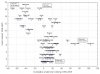
In the attached file, I have plotted the cumulative over/under-rank score that Stassen provides against the number of years the teams are ranked. If you right click and save the file, you should be able to zoom in with your picture editor.
Five teams have been ranked most often. Miami, followed by Ohio State, TSUN, Nebraska, and Tennessee. Of those teams, Ohio State is the only team to not be consistently over-ranked by one place or more over the years.
Four interesting clusters of teams emerge from the biplot.
Ten frequently ranked teams appear to be the most over-ranked: TSUN, Southern California, Notre Dame, Texas, Nebraska, Cryami, Tennessee, Florida State, Florida, Texas A&M
Ohio State is among the teams that are frequently and fairly ranked,with our rank being about 1 off at the end of each season.
Georgia Tech, Washington State, and Oregon are three teams that seem to surprise pollsters from time to time. They are not frequently ranked in the preseason and end up beating the predictions by a lot over time.
It is easy to see how many places on average teams have been over-ranked during the period. Just divide the cumulative score by the number of years ranked.
Sorry that I can't clear up the fairly ranked teams better, but then they are not really all that interesting anyway and can be determined easily from Stassen's table.
Hope you guys find this interesting.
Stassen subtracts final season ratings for pre-season ranked teams and then adds these together to come to a cumulative over- and under-ranked team measure for the period 1989 to 2005.
Stassen's spreadsheet is really welcome, but it doesn't really tell us which teams are over-ranked consistently. That is because adding the differences doesn't allow us to sift out the information about how often teams were ranked. This means that a team that is ranked two places higher every year for the sixteen years will have a score of 32. While a team that is ranked four places higher for eight of those years would have the same score.
So, the team that is on average ranked most unfairly is hidden.
In the attached file, I have plotted the cumulative over/under-rank score that Stassen provides against the number of years the teams are ranked. If you right click and save the file, you should be able to zoom in with your picture editor.
Five teams have been ranked most often. Miami, followed by Ohio State, TSUN, Nebraska, and Tennessee. Of those teams, Ohio State is the only team to not be consistently over-ranked by one place or more over the years.
Four interesting clusters of teams emerge from the biplot.
Ten frequently ranked teams appear to be the most over-ranked: TSUN, Southern California, Notre Dame, Texas, Nebraska, Cryami, Tennessee, Florida State, Florida, Texas A&M
Ohio State is among the teams that are frequently and fairly ranked,with our rank being about 1 off at the end of each season.
Georgia Tech, Washington State, and Oregon are three teams that seem to surprise pollsters from time to time. They are not frequently ranked in the preseason and end up beating the predictions by a lot over time.
It is easy to see how many places on average teams have been over-ranked during the period. Just divide the cumulative score by the number of years ranked.
Sorry that I can't clear up the fairly ranked teams better, but then they are not really all that interesting anyway and can be determined easily from Stassen's table.
Hope you guys find this interesting.
Attachments
Last edited: