


ScriptOhio
Everybody is somebody else's weirdo.
Report: Compton can use cart in Q-school after heart transplant
Kevin C. Cox/Getty Images
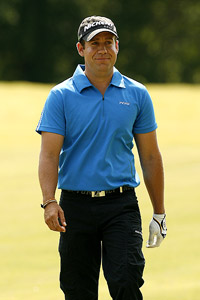
Erik Compton, shown in an April 2007 tournament, is getting back into competitive golf.
Erik Compton has the heart. He just doesn't have the stamina. So the PGA Tour is going to help him out.
Just four months after the second heart transplant of his life, the former Georgia All-American learned that officials have granted his request to use a cart during qualifying school to earn his tour card. The South Florida Sun-Sentinel first reported the story Tuesday on its Web site.
"I feel really good about the news," Compton said, according to the Sun-Sentinel. "It takes a lot of stress off me, and it gives me a realistic chance."
Compton, 28, will play the first stage of qualifying from Oct. 21-24 at Crandon Golf at Key Biscayne, Fla. He is a former No. 1 junior golfer who won on the Canadian and Hooters Tours and played on the Nationwide Tour.
Compton told the newspaper that he has also been granted a waiver to use a beta blocker, which is on the PGA Tour's list of banned substances, because he needs it as part of his medication protocol.
Heart disease caused Compton to have a heart transplant at age 12. Transplanted hearts last an average of 11 years, but his survived for 16. Then in October 2007, Compton suffered a near-fatal heart attack while fishing. He was stabilized, but it was only a matter of time before he would need a new heart.
In May, he was hospitalized again for observation and given medication to help his heart function. He was about to go home with a nurse that would provide 24-hour care when a new heart became available.
The Compton case stands in sharp contrast to that of Casey Martin. A birth defect in his leg prevented him from walking the course, but he had to sue the tour to use a cart.
While his case went through the courts, Martin was granted the right to use a cart at the 1997 Q-school. He played the Nike Tour in 1998 (won a tournament) and tied for 23rd at the U.S. Open. He earned his PGA Tour card for 2000 by finishing 14th on the Nike money list in 1999 but failed to keep his card. In 2001, he won his suit that went to the Supreme Court which allowed him to use a cart under the Americans With Disabilities Act.
He's now the golf coach at the University of Oregon.
Entire article: ESPN - Report: Compton can use cart in Q-school after heart transplant - Golf
Kevin C. Cox/Getty Images
Erik Compton, shown in an April 2007 tournament, is getting back into competitive golf.
Erik Compton has the heart. He just doesn't have the stamina. So the PGA Tour is going to help him out.
Just four months after the second heart transplant of his life, the former Georgia All-American learned that officials have granted his request to use a cart during qualifying school to earn his tour card. The South Florida Sun-Sentinel first reported the story Tuesday on its Web site.
"I feel really good about the news," Compton said, according to the Sun-Sentinel. "It takes a lot of stress off me, and it gives me a realistic chance."
Compton, 28, will play the first stage of qualifying from Oct. 21-24 at Crandon Golf at Key Biscayne, Fla. He is a former No. 1 junior golfer who won on the Canadian and Hooters Tours and played on the Nationwide Tour.
Compton told the newspaper that he has also been granted a waiver to use a beta blocker, which is on the PGA Tour's list of banned substances, because he needs it as part of his medication protocol.
Heart disease caused Compton to have a heart transplant at age 12. Transplanted hearts last an average of 11 years, but his survived for 16. Then in October 2007, Compton suffered a near-fatal heart attack while fishing. He was stabilized, but it was only a matter of time before he would need a new heart.
In May, he was hospitalized again for observation and given medication to help his heart function. He was about to go home with a nurse that would provide 24-hour care when a new heart became available.
The Compton case stands in sharp contrast to that of Casey Martin. A birth defect in his leg prevented him from walking the course, but he had to sue the tour to use a cart.
While his case went through the courts, Martin was granted the right to use a cart at the 1997 Q-school. He played the Nike Tour in 1998 (won a tournament) and tied for 23rd at the U.S. Open. He earned his PGA Tour card for 2000 by finishing 14th on the Nike money list in 1999 but failed to keep his card. In 2001, he won his suit that went to the Supreme Court which allowed him to use a cart under the Americans With Disabilities Act.
He's now the golf coach at the University of Oregon.
Entire article: ESPN - Report: Compton can use cart in Q-school after heart transplant - Golf