
Install the app
How to install the app on iOS
Follow along with the video below to see how to install our site as a web app on your home screen.

Note: This feature currently requires accessing the site using the built-in Safari browser.
-
New here? Register here now for access to all the forums, download game torrents, private messages, polls, Sportsbook, etc. Plus, stay connected and follow BP on Instagram @buckeyeplanet and Facebook.
You are using an out of date browser. It may not display this or other websites correctly.
You should upgrade or use an alternative browser.
You should upgrade or use an alternative browser.
Deciding When to Retire
- Thread starter CincyInterloper
- Start date




If you still enjoy and are fulfilled with what you are doing, there is no reason to retire.Going through this process now. Just turned 50 and next year is my year to qualify for state retirement. I can lock it in and come back to work..."double dip". However, I become at at will employee and can be dismissed at any time.
Definitely not ready to stop working but trying to figure out the best financial route.
Upvote
0

I have had the same hair brush for 55 years. The same hairstyle, too.I'll also confess that since I bought my first car at 17 I'ved own 4 cars. I also have the same alarm clock that I bought in an Anchorage thrift store in 1989.
Upvote
0

CincyInterloper
Hall of Fame
So things we can live without have gotten cheaper while necessities have gotten more expensive. Have the markets for necessities gotten less competitive while the markets for luxury goods have gotten more competitive? And if so, how do we restore competitiveness to these markets? Heath-care and education in particular seem to be, to use a technical term, out of wack.
That might work if it wasn't for the pesky basket of goods you are trying to purchase increasing significantly faster.
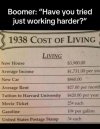
$100 of medical care in 1980 = ~$800 today
$100 of tuition in 1980 = ~$1,280 today
~$64K house in 1980 = ~$400K today
Like I said in the post that started this, the math is working against people. If pay goes up 4x and the stuff you need to buy goes up 8-12x...you have a lot less room for error.
EDIT
This is just since 200 for a good quick visual. The mistake is to believe the fucking government about "core CPI" and think wages have done anything remotely close to keeping up.
So the real financial mistake people can make is not tattoos or pot. The mistake is getting sick, having kids, getting an education or trying to buy a house.
Electronics are depreciating though. So we've got that going for us. Which is nice.


Upvote
0

Oh no I'd still work...just figuring out if I want to double dip with the same district.If you still enjoy and are fulfilled with what you are doing, there is no reason to retire.
Upvote
0

So, the math checks out, but the conclusion does not. So, 200% is 3x, which is exactly the additional amount deducted from our employees checks for PPO health insurance. $40 per pay period 25 years ago. $120 deducted from our employees’ checks today. However, the additional $80 is easily offset by the additional $800 in wages earned during that pay period. Same is true if saving for a child’s education. Enroll in a 529 and put $20 a week in the plan. Kids education paid in full by the time they are of age. The world is suffering from financial illiteracy, not lack of resources. That $30 a week for $4.4 million dollars still seems like world’s biggest no brainer to me!
That might work if it wasn't for the pesky basket of goods you are trying to purchase increasing significantly faster.
$100 of medical care in 1980 = ~$800 today
$100 of tuition in 1980 = ~$1,280 today
~$64K house in 1980 = ~$400K today
Like I said in the post that started this, the math is working against people. If pay goes up 4x and the stuff you need to buy goes up 8-12x...you have a lot less room for error.
EDIT
This is just since 200 for a good quick visual. The mistake is to believe the fucking government about "core CPI" and think wages have done anything remotely close to keeping up.
L
So the real financial mistake people can make is not tattoos or pot. The mistake is getting sick, having kids, getting an education or trying to buy a house.
Electronics are depreciating though. So we've got that going for us. Which is nic
Upvote
0
One other massive piece of advice for those planning for their financial futures. Never, and I mean NEVER, put more in your 401k than the amount you need to get the employer match. If you want to invest additional funds post tax, get yourself in a tax managed brokerage account. For reference, you will never have to worry about all the bullshit rules with RMD’s, etc. My account is managed by Fidelity. They typically achieve gains that exceed the indexes by a wide margin, and the tax harvesting algorithms usually produce a minimum 6 figure tax loss every year. It is life changing when you actually get to keep what you earn.
Upvote
0

DubCoffman62
Lazy Slob
I don't even own one and I have a head full of hairI have had the same hair brush for 55 years. The same hairstyle, too.
Upvote
0
DubCoffman62
Lazy Slob
So things we can live without have gotten cheaper while necessities have gotten more expensive. Have the markets for necessities gotten less competitive while the markets for luxury goods have gotten more competitive? And if so, how do we restore competitiveness to these markets? Heath-care and education in particular seem to be, to use a technical term, out of wack.
Upvote
0
Always bet on yourself. Double dip.Oh no I'd still work...just figuring out if I want to double dip with the same district.
Upvote
0

So, the math checks out, but the conclusion does not. So, 200% is 3x, which is exactly the additional amount deducted from our employees checks for PPO health insurance. $40 per pay period 25 years ago. $120 deducted from our employees’ checks today. However, the additional $80 is easily offset by the additional $800 in wages earned during that pay period. Same is true if saving for a child’s education. Enroll in a 529 and put $20 a week in the plan. Kids education paid in full by the time they are of age. The world is suffering from financial illiteracy, not lack of resources. That $30 a week for $4.4 million dollars still seems like world’s biggest no brainer to me!
You have a lot of assumptions at work here to fit your argument and the fact that you need to get this cute with numbers to even still not be able to defend your position that this is all because people are stupid and lazy should tell you something.
First, the deductions for health insurance are in no way shape or form a proxy for the real increase in cost of healthcare. That insults the intelligence to even try. Again, you are ignoring the expense of it and how much that has outpaced wage growth.
Second, putting 20 a week into a 529 plan is no where near enough to pay for college "in full" by the time they are 18-19. That is patently false.
20x 52 = $1,040 do that for 18 years and you are talking about less than 20K. You might be able to get 45-50K out of that. Pretty fucking far from college paid in full.
Lastly, I let it go last time but you keep going back there, $30 a week isn't going to be $4.4MM
Contribution | Annual return | Time | Ending value |
|---|---|---|---|
$30/week | 12% | 40 years | ~$1.27M |
$30/week | 12% | 50 years | ~$3.96M |
$30/week | 12% | 51 years | ~$4.48M |
$30/week | 10% | 50 years | ~$1.90M |
$30/week | 8% | 50 years | ~$930K |
Bottom line is you are, intentionally I think, ignoring the cost side of the equation. Showing someone that they could save X in todays dollars out into the future without applying the haircut for inflation over that same period is disingenuous at best. Even if your 4.4MM was accurate (it isn't but lets just roll with it) do you have the side by side of what 4.4MM in todays dollars would be if you apply a 3-4% inflation tax (because that is what it is) to the returns for the same time period?
Here is what you are looking at if you are realistic with people:
$30 × 52 × 25 = $39,000
Annual investment return | Future nominal value after 25 years | Value in today’s dollars at 3% inflation | Value in today’s dollars at 4% inflation | Value in today’s dollars at 5% inflation |
|---|---|---|---|---|
8% | $118,461 | $56,578 | $44,437 | $34,982 |
10% | $160,823 | $76,810 | $60,327 | $47,492 |
15% | $355,796 | $169,930 | $133,465 | $105,067 |
Upvote
0
I’m getting “cute“ by using tangible evidence? C’mon dude. You missed (or got cute?) by ignoring the company match on the 401k. You don’t get the match if you don’t invest. With that match, you get to $4.4 million dollars using a compound interest calculator using the exact history of the S&P 500. Go back to my original post if you aren’t understanding the entire scope of the math.You have a lot of assumptions at work here to fit your argument and the fact that you need to get this cute with numbers to even still not be able to defend your position that this is all because people are stupid and lazy should tell you something.
First, the deductions for health insurance are in no way shape or form a proxy for the real increase in cost of healthcare. That insults the intelligence to even try. Again, you are ignoring the expense of it and how much that has outpaced wage growth.
Second, putting 20 a week into a 529 plan is no where near enough to pay for college "in full" by the time they are 18-19. That is patently false.
20x 52 = $1,040 do that for 18 years and you are talking about less than 20K. You might be able to get 45-50K out of that. Pretty fucking far from college paid in full.
Lastly, I let it go last time but you keep going back there, $30 a week isn't going to be $4.4MM
Even if you juice up the returns to fantasy levels, never allow for losses, timing, breaks in income/contributions or any other life events it doesn't get there.
Bottom line is you are, intentionally I think, ignoring the cost side of the equation. Showing someone that they could save X in todays dollars out into the future without applying the haircut for inflation over that same period is disingenuous at best. Even if your 4.4MM was accurate (it isn't but lets just roll with it) do you have the side by side of what 4.4MM in todays dollars would be if you apply a 3-4% inflation tax (because that is what it is) to the returns for the same time period?
Here is what you are looking at if you are realistic with people:
$30 × 52 × 25 = $39,000
Upvote
0
Compound interest on 18 years of $20 per week for college….I‘m not even including the tax discount.You have a lot of assumptions at work here to fit your argument and the fact that you need to get this cute with numbers to even still not be able to defend your position that this is all because people are stupid and lazy should tell you something.
First, the deductions for health insurance are in no way shape or form a proxy for the real increase in cost of healthcare. That insults the intelligence to even try. Again, you are ignoring the expense of it and how much that has outpaced wage growth.
Second, putting 20 a week into a 529 plan is no where near enough to pay for college "in full" by the time they are 18-19. That is patently false.
20x 52 = $1,040 do that for 18 years and you are talking about less than 20K. You might be able to get 45-50K out of that. Pretty fucking far from college paid in full.
Lastly, I let it go last time but you keep going back there, $30 a week isn't going to be $4.4MM
Even if you juice up the returns to fantasy levels, never allow for losses, timing, breaks in income/contributions or any other life events it doesn't get there.
Bottom line is you are, intentionally I think, ignoring the cost side of the equation. Showing someone that they could save X in todays dollars out into the future without applying the haircut for inflation over that same period is disingenuous at best. Even if your 4.4MM was accurate (it isn't but lets just roll with it) do you have the side by side of what 4.4MM in todays dollars would be if you apply a 3-4% inflation tax (because that is what it is) to the returns for the same time period?
Here is what you are looking at if you are realistic with people:
$30 × 52 × 25 = $39,000

Upvote
0
Here is actually the best way to do it. Take out government loans for the education costs. No payments and the government pays the interest for 5 years. Post graduation, you pay it all off with the pot of gold at the end of the rainbow….You have a lot of assumptions at work here to fit your argument and the fact that you need to get this cute with numbers to even still not be able to defend your position that this is all because people are stupid and lazy should tell you something.
First, the deductions for health insurance are in no way shape or form a proxy for the real increase in cost of healthcare. That insults the intelligence to even try. Again, you are ignoring the expense of it and how much that has outpaced wage growth.
Second, putting 20 a week into a 529 plan is no where near enough to pay for college "in full" by the time they are 18-19. That is patently false.
20x 52 = $1,040 do that for 18 years and you are talking about less than 20K. You might be able to get 45-50K out of that. Pretty fucking far from college paid in full.
Lastly, I let it go last time but you keep going back there, $30 a week isn't going to be $4.4MM
Even if you juice up the returns to fantasy levels, never allow for losses, timing, breaks in income/contributions or any other life events it doesn't get there.
Bottom line is you are, intentionally I think, ignoring the cost side of the equation. Showing someone that they could save X in todays dollars out into the future without applying the haircut for inflation over that same period is disingenuous at best. Even if your 4.4MM was accurate (it isn't but lets just roll with it) do you have the side by side of what 4.4MM in todays dollars would be if you apply a 3-4% inflation tax (because that is what it is) to the returns for the same time period?
Here is what you are looking at if you are realistic with people:
$30 × 52 × 25 = $39,000

Upvote
0



You guys realize that you’re giving long term financial planning advice to a bunch of 50+ yo people?
Upvote
0