Install the app
How to install the app on iOS
Follow along with the video below to see how to install our site as a web app on your home screen.
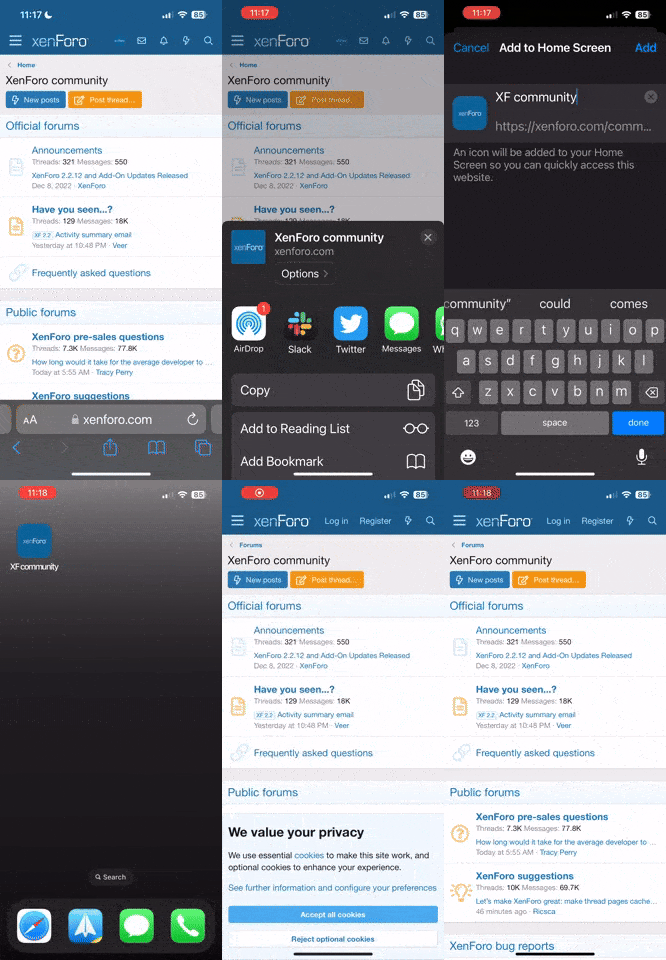
Note: This feature currently requires accessing the site using the built-in Safari browser.
-
New here? Register here now for access to all the forums, download game torrents, private messages, polls, Sportsbook, etc. Plus, stay connected and follow BP on Instagram @buckeyeplanet and Facebook.
You are using an out of date browser. It may not display this or other websites correctly.
You should upgrade or use an alternative browser.
You should upgrade or use an alternative browser.
Print Your Own Monopoly Money
- Thread starter LoKyBuckeye
- Start date



they didn't even tell us what kind of paper to print it on! They expect this lazy generation to figure it out on our own?
Upvote
0

ScriptOhio
Everybody is somebody else's weirdo.
Starting in 1941, an increasing number of British airmen found themselves asthe involuntaryguests of the Third Reich, and the Crown was casting about for ways andmeans to facilitatetheir escape. Now obviously, one of the most helpful aids to that end is a useful and accuratemap, one showing not only where stuff was, but also showing the locations of'safe houses' where a POW on-the-lam could go for food and shelter.
Paper maps had some real drawbacks -- they make a lot of noise when you openand foldthem, they wear out rapidly, and if they get wet, they turn into mush.
Someone in MI-5 (similar to America's OSS) got the idea of printing escapemaps on silk.It's durable, can bescrunched-up into tiny wads, and unfolded as many times as needed,and makes no noise whatsoever.
At that time, there was only one manufacturer in Great Britain that hadperfected the technologyof printing on silk, and that was John Waddington, Ltd. When approached bythe government,the firm was only too happy to do its bit for the war effort.
By pure coincidence, Waddington was also the U.K. Licensee for the popularAmerican boardgame, Monopoly. As it happened, 'games and pastimes' was a category of itemqualified for insertion into 'CARE packages', dispatched by the International Red Cross toprisoners of war.
Under the strictest of secrecy, in a securely guarded and inaccessible oldworkshop on thegrounds of Waddington's, a group of sworn-to-secrecy employees beganmass-producingescape maps, keyed to each region of Germany or Italy where Allied POW campswereregional system). When processed, these maps could be folded into such tiny dots that they would actually fit inside a Monopoly playing piece. As long as they were atit, the cleverworkmen at Waddington's also managed to add:
1. A playing token, containing a small magnetic compass,
2. A two-part metal file that could easily be screwedtogether,
3. Useful amounts of genuine high-denomination German, Italian, andFrench currencyhidden within the piles of Monopoly money!
British and American air crews were advised, before taking off on theirfirst mission, howto identify a 'rigged' Monopoly set -- by means of a tiny red dot, onecleverly rigged tolook like an ordinary printing glitch, located in the corner of the FreeParking square.
Of the estimated 35,000 Allied POWS who successfully escaped, an estimated one-thirdwere aided in their flight by the rigged Monopoly sets. Everyone who did sowas swornto secrecy indefinitely, since the British Government might want to use thishighly successful ruse in still another, future war. The story wasn't de-classified until2007, when thesurviving craftsmen from Waddington's, as well as the firm itself, werefinally honoredin a public ceremony.
It's always nice when you can play that 'Get Out of Jail' Free' card!
I realize most of you are (probably) too young to have any personalconnection toWWII (Dec.. '41to Aug. '45), but this is still interesting.
true story: http://www.snopes.com/military/monopoly.asp
Paper maps had some real drawbacks -- they make a lot of noise when you openand foldthem, they wear out rapidly, and if they get wet, they turn into mush.
Someone in MI-5 (similar to America's OSS) got the idea of printing escapemaps on silk.It's durable, can bescrunched-up into tiny wads, and unfolded as many times as needed,and makes no noise whatsoever.
At that time, there was only one manufacturer in Great Britain that hadperfected the technologyof printing on silk, and that was John Waddington, Ltd. When approached bythe government,the firm was only too happy to do its bit for the war effort.
By pure coincidence, Waddington was also the U.K. Licensee for the popularAmerican boardgame, Monopoly. As it happened, 'games and pastimes' was a category of itemqualified for insertion into 'CARE packages', dispatched by the International Red Cross toprisoners of war.
Under the strictest of secrecy, in a securely guarded and inaccessible oldworkshop on thegrounds of Waddington's, a group of sworn-to-secrecy employees beganmass-producingescape maps, keyed to each region of Germany or Italy where Allied POW campswereregional system). When processed, these maps could be folded into such tiny dots that they would actually fit inside a Monopoly playing piece. As long as they were atit, the cleverworkmen at Waddington's also managed to add:
1. A playing token, containing a small magnetic compass,
2. A two-part metal file that could easily be screwedtogether,
3. Useful amounts of genuine high-denomination German, Italian, andFrench currencyhidden within the piles of Monopoly money!
British and American air crews were advised, before taking off on theirfirst mission, howto identify a 'rigged' Monopoly set -- by means of a tiny red dot, onecleverly rigged tolook like an ordinary printing glitch, located in the corner of the FreeParking square.
Of the estimated 35,000 Allied POWS who successfully escaped, an estimated one-thirdwere aided in their flight by the rigged Monopoly sets. Everyone who did sowas swornto secrecy indefinitely, since the British Government might want to use thishighly successful ruse in still another, future war. The story wasn't de-classified until2007, when thesurviving craftsmen from Waddington's, as well as the firm itself, werefinally honoredin a public ceremony.
It's always nice when you can play that 'Get Out of Jail' Free' card!
I realize most of you are (probably) too young to have any personalconnection toWWII (Dec.. '41to Aug. '45), but this is still interesting.
true story: http://www.snopes.com/military/monopoly.asp
Upvote
0